 AXIS-SGInternational Design Awards
Winners · 2025
2025 Winners
Ten winning projects from 2025. Open a project to read the jury notes and the designer’s own account of the work.
Interior Design
5 awarded projects
Interior Design
Sage Apartment
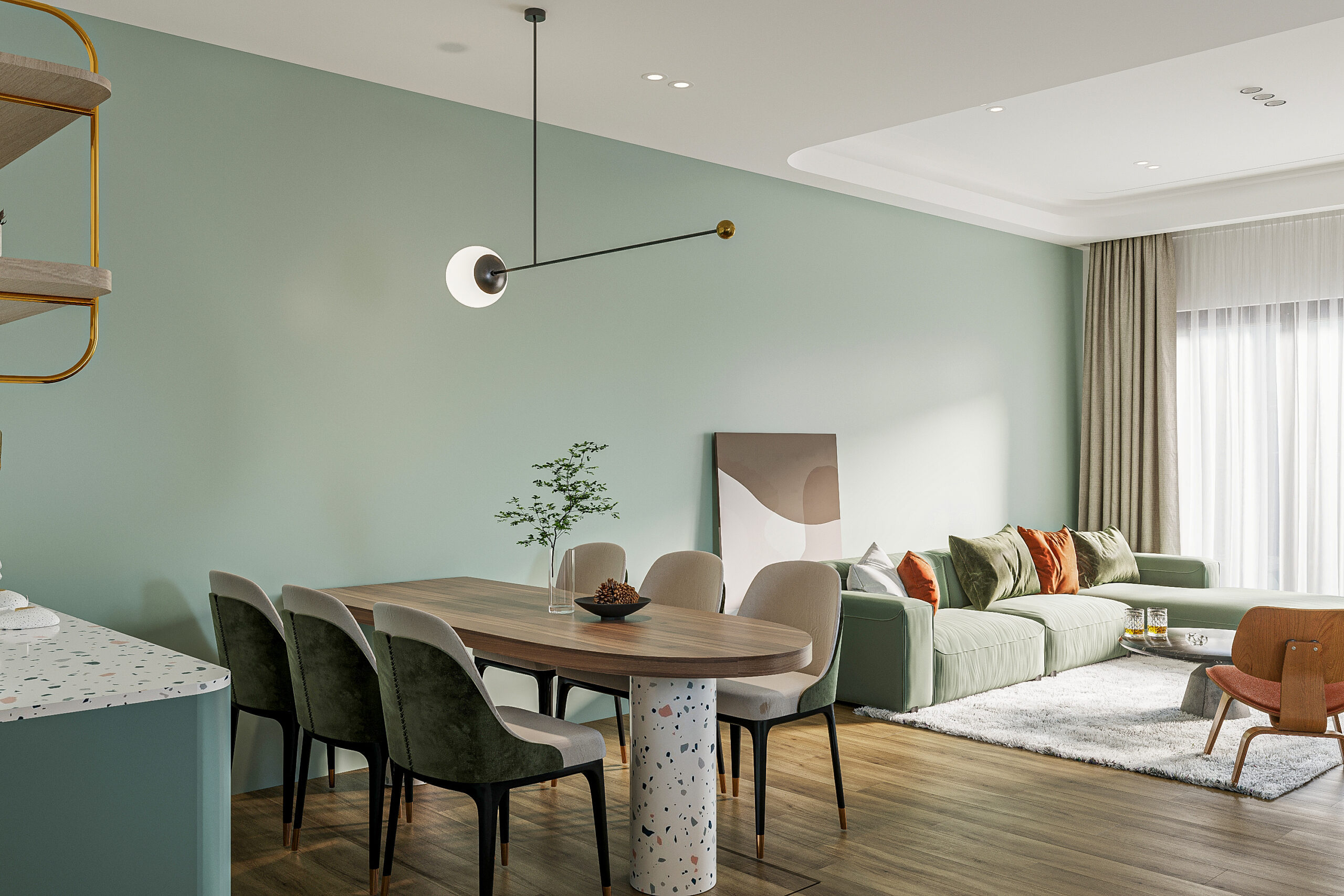
Most apartments of this size arrive in white and stay there. Nine Dots Design painted the long wall sage green and built everything else against it.
Read full story
The green runs unbroken from the kitchen counter to the far corner, wrapping the dining zone and stopping where the living room ceiling drops into a rounded recess. It is a flat matt emulsion with no trim, no dado and no artwork, so the wall reads as a field rather than as a surface with things on it. The single leaning canvas by the sofa is the only object allowed to touch it.
The dining table is the room's centrepiece: a walnut top with a soft oval outline, carried on one terrazzo cylinder. That terrazzo — white with orange, pink and grey chips — reappears in the kitchen counter and nowhere else, which ties the two zones without repeating the same move across the flat. Six chairs alternate between olive and cream velvet on black legs with brass feet, a mix the studio chose so the table never looks like a showroom set.
A single pendant crosses the table on a long black arm with a brass counterweight at the far end, hung off-centre on purpose so that the light sits over the seats rather than the middle of the top.
The living area is softer: a mint modular sofa, orange and olive cushions, a moulded plywood lounge chair, a deep white rug over oak flooring.
The jury gave this the category's Platinum for its colour discipline. Green, terrazzo, walnut and brass, used in that order of weight, with nothing added afterward.
Design team
Nine Dots Design is a Singapore studio of seven working on private apartments and small retail. It was founded in 2017 by Rachel Ong and Danny Teo, both formerly with larger commercial practices, and takes around ten projects a year. The office does its own colour mixing on site rather than specifying from a chart, and keeps a wall of painted boards from every completed project. Most of its furniture is drawn in-house and made by two workshops in Johor.
Interior Design
Moon Window
A small café in Chiang Mai with an awkward plan: a service stair on one side, a narrow dining room on the other, and a stub of wall between them that could not be removed.
Read full story
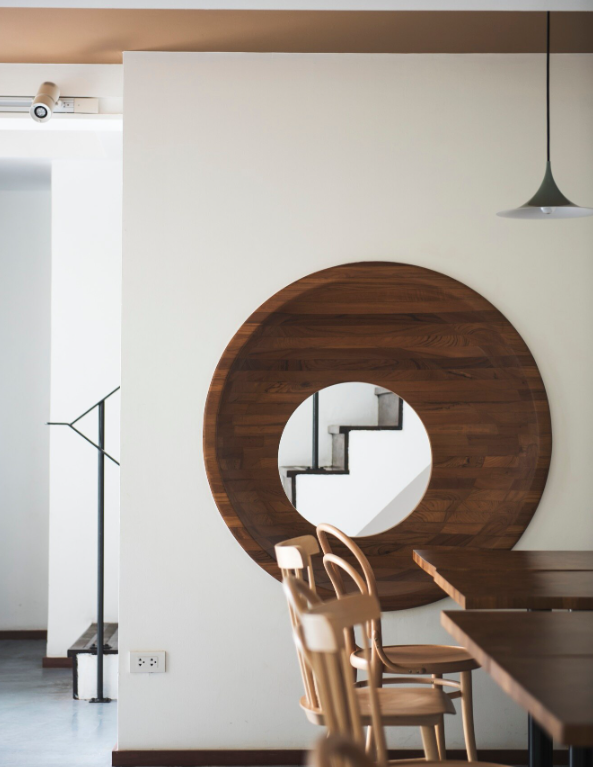
Table Two Design turned that stub into the project. A disc of solid walnut, just under two metres across, is set into the white plaster and pierced by a circular opening at its centre. Through the hole you see the stair beyond, its black steel stringer and treads framed like a picture. Sit at the tables and the view changes as people climb.
The disc is built from narrow staves glued edge to edge, with the grain running horizontally so the joints read as fine lines across the face. Its outer edge is chamfered back into the wall, which removes the shadow line and makes the walnut look inset rather than applied.
Everything else in the room stays quiet. Bentwood chairs in pale beech, walnut tabletops on black frames, a single green cone pendant, polished concrete underfoot. Wall and ceiling are the same off-white. Track spots are aimed at the disc and at nothing else.
The jury liked the economy of the idea. One element, made well, carrying a room that had no other feature to work with. Gold rather than Platinum because the rest of the café is standard, and because the walnut disc has no relationship to the service counter behind the camera.
Design team
Table Two Design is a two-person office in Chiang Mai, run by Nat Suwannarat and Ploy Intra since 2019. Both trained as furniture makers and still build a share of the joinery on their own projects, which is unusual and shows in the detail quality of their timber work. The studio takes three or four small commercial fit-outs a year, nearly all cafés and shops in the old city, and turns down anything it cannot visit weekly. Suwannarat handles drawings and Intra the making; neither has hired staff and both say they have no plans to.
Interior Design
Warm Grey Apartment
A three-bedroom apartment in Taichung, planned around a single long wall and the fireplace built into it.
Read full story
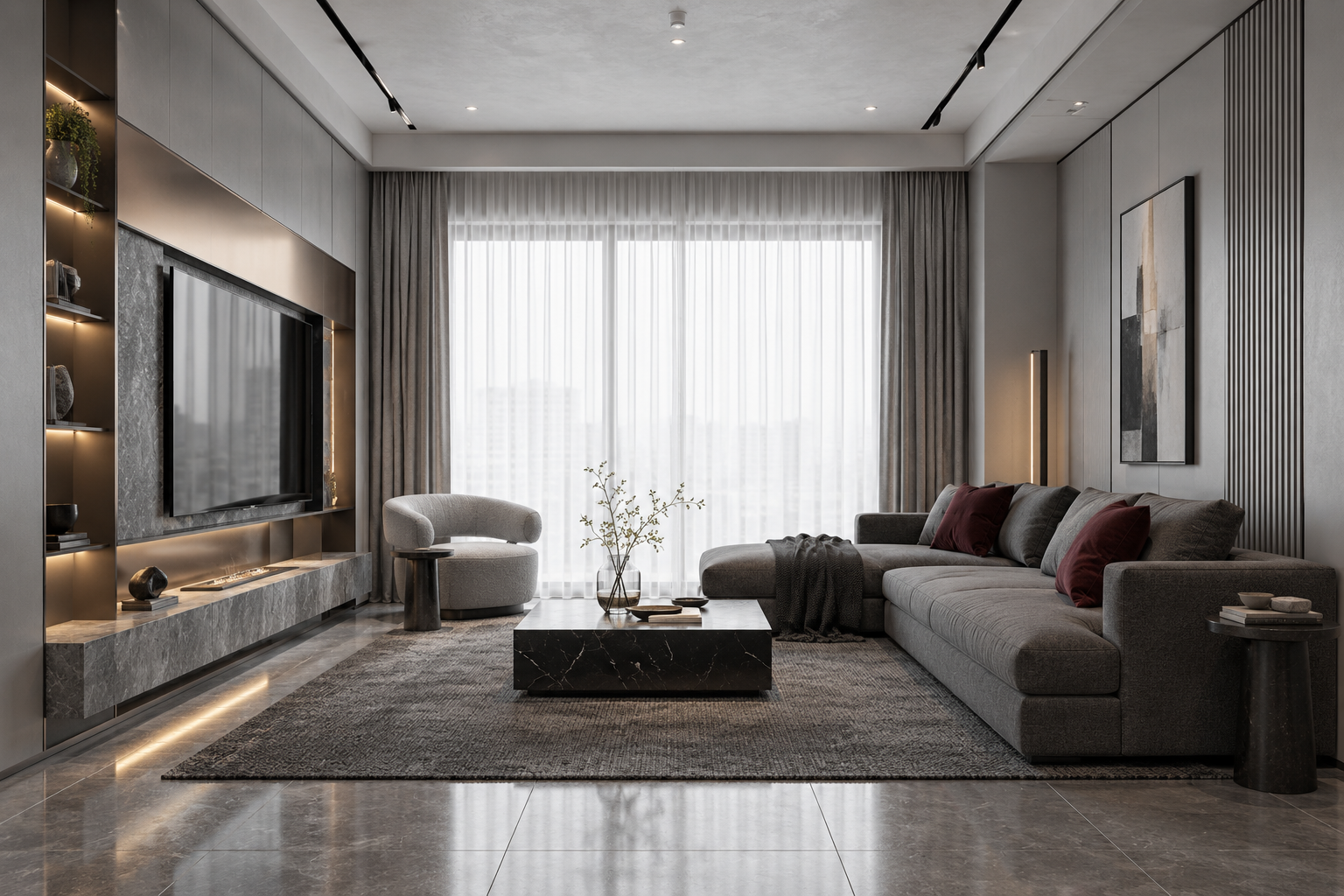
The wall carries a slab of grey marble with heavy white veining, running behind the television and continuing down into a stone bench that houses a linear gas fire. Above and to the sides, bronze-tinted metal frames a tall run of shelving, lit from within by warm strips so the niches glow after dark while the marble stays in shadow. The composition is asymmetric on purpose: shelving on the left, storage doors on the right, screen off-centre.
Seating is a deep charcoal sectional with a wide chaise, dressed with burgundy velvet cushions. That burgundy is the only strong colour in the flat and appears nowhere else. In front of it sits a black marble coffee table cut as a single thick block, and a cream bouclé barrel chair by the window softens what would otherwise be a room of hard edges.
The right-hand wall is fluted timber in a mid grey, running floor to ceiling, with one framed abstract hung on it.
Curtains are layered: sheer white behind, heavy taupe in front, both on recessed tracks. A slim floor lamp stands between them.
The jury praised the lighting design, particularly the recessed floor wash at the base of the media wall, and the confidence of the burgundy. It withheld Platinum because the layout is conventional and the room, for all its polish, could be in any of a dozen cities.
Design team
Line Interior Studio works from Taichung with a team of eleven, split between design and site supervision. Founded in 2013, the office builds mainly for developers' show units and private apartment owners in central Taiwan, and has developed a specialism in concealed lighting — every project ships with a lighting layout the client can adjust by scene. It runs its own metal fabrication contact in Changhua for the bronze framing that appears across much of its work.
Interior Design
Open Frame Home
A family apartment in Kuala Lumpur, opened up by removing the wall between the living room and a rarely used study.
Read full story
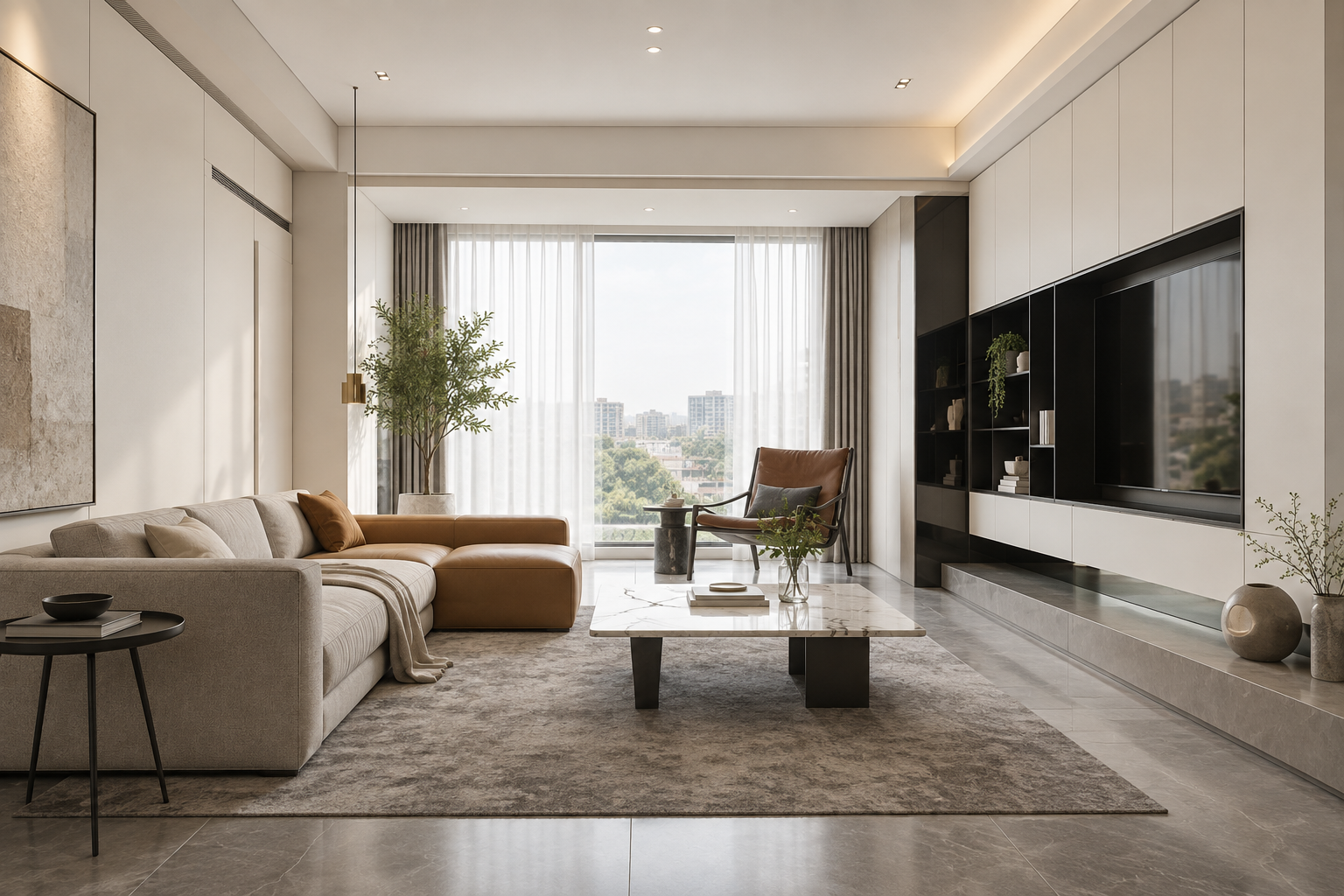
Third Light Design's main move is the media wall. Rather than a closed run of cabinetry, it is a black steel frame with open bays, set against white joinery and carried on a stone plinth that runs the full width and continues past the television as a low bench. The bays hold books, small ceramics and a trailing plant. Nothing is styled to fill them.
The seating is a pale linen sectional with a tan leather chaise section that reads as a separate piece, which is how the studio kept a large sofa from dominating a room with only one window wall. A white marble coffee table on dark tapered legs sits low in front of it. Beside the window, a leather sling chair and a small stone side table make a reading corner that faces out rather than in.
Light is the project's real subject. The glazing is screened by sheers with heavy grey drapes at the edges, and the studio removed a bulkhead to bring the ceiling line up to the window head. An olive tree stands in the brightest corner.
The jury found the work well proportioned and pleasant, and singled out the stone plinth as a good solution to a common problem. It sits at Selection because the vocabulary is widely used in the region and the project does not extend it.
Design team
Third Light Design is a Kuala Lumpur practice of six, founded in 2018 by Hafiz Rahman. The office works almost entirely on high-rise apartment renovations and has built a reputation for daylight planning in units with a single aspect. It publishes a short daylight study with every proposal. Rahman previously worked in lighting consultancy, and the studio still takes on lighting-only commissions for other designers, which accounts for roughly a fifth of its work. The office keeps a stock of tested fittings on site so clients can compare them at full brightness before specifying.
Interior Design
Morning Room
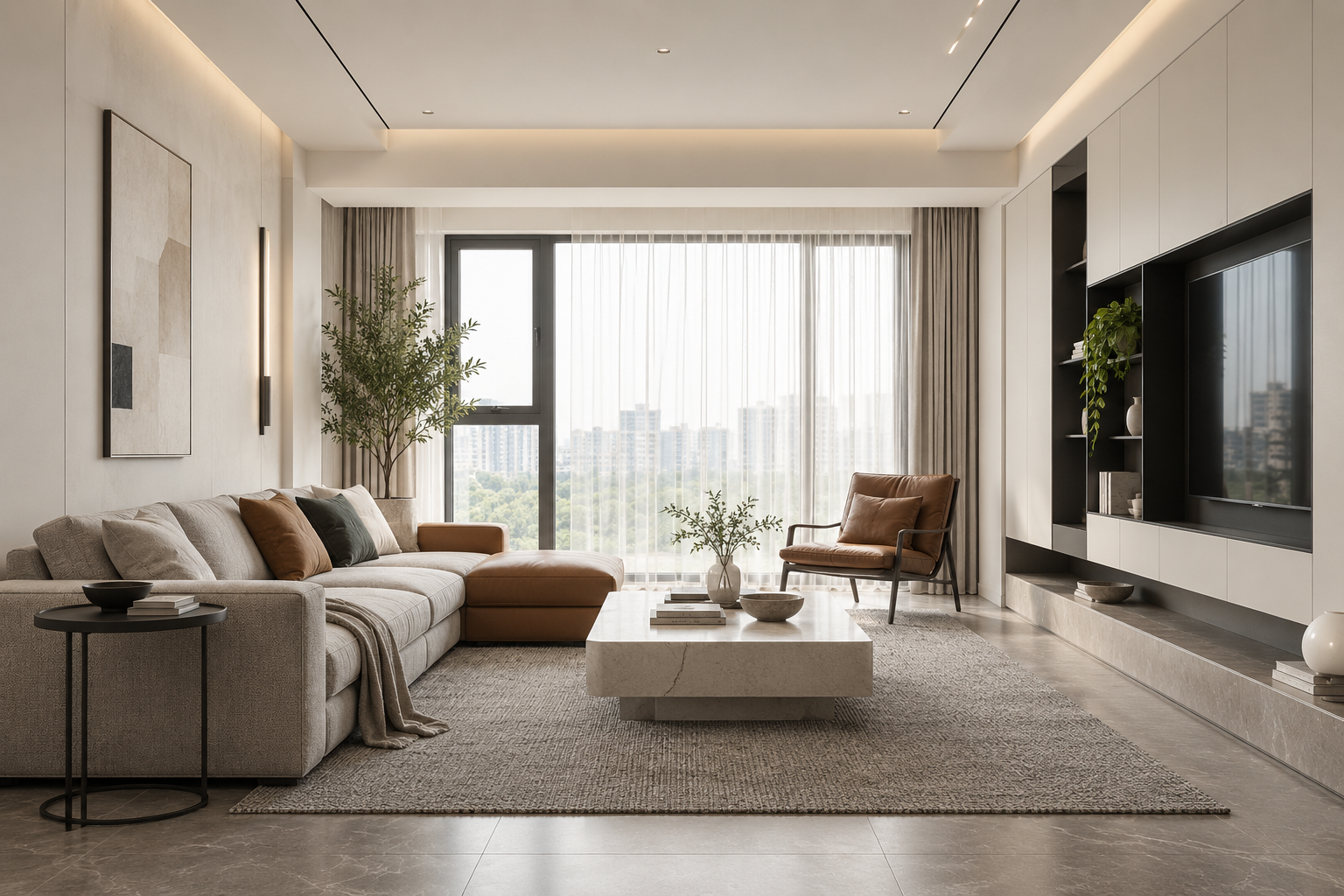
An apartment in Seongnam, renovated for a couple who wanted the living room to work as their main daytime space rather than an evening one.
Read full story
That brief drove the orientation. The sofa faces the window rather than the television, and the heaviest piece in the room is a travertine coffee table placed where the morning sun lands. Han and Park Interiors argued that a room used at nine in the morning needs its mass in the light, not against the wall.
The sectional is a pale grey linen with a tan leather ottoman section, cushioned in rust and dark green. A brown leather armchair with a black steel frame sits by the glazing. Against the opposite wall, white joinery holds the television inside a black recess, with open shelving alongside for plants and books and a stone plinth beneath.
The ceiling carries a stepped cove that lifts the perimeter and hides the curtain track. A slim vertical wall light beside the artwork is the only fixture at eye level.
Materials are limited to four: pale plaster, white lacquer, travertine and oak. The rug is a coarse loop weave in warm grey, laid short of the window so the floor tile shows in the brightest strip of the room.
The jury liked the plan logic and the travertine block. It placed the project at Selection because the execution, while clean, follows a template the studio has used before, and the shelving styling is generic.
Design team
Han and Park Interiors is a Seoul office of nine, established in 2015 by Han Ji-eun and Park Sung-ho. It works on apartment renovations in the Seoul metropolitan area and produces roughly twenty projects a year, a volume it manages by keeping a fixed detail library and a standing relationship with three contractors. The studio is known locally for its window and curtain detailing. It runs an open evening once a month where prospective clients can walk through a completed unit.
Furniture Design
5 awarded projects
Furniture Design
Stacked Oak Chair
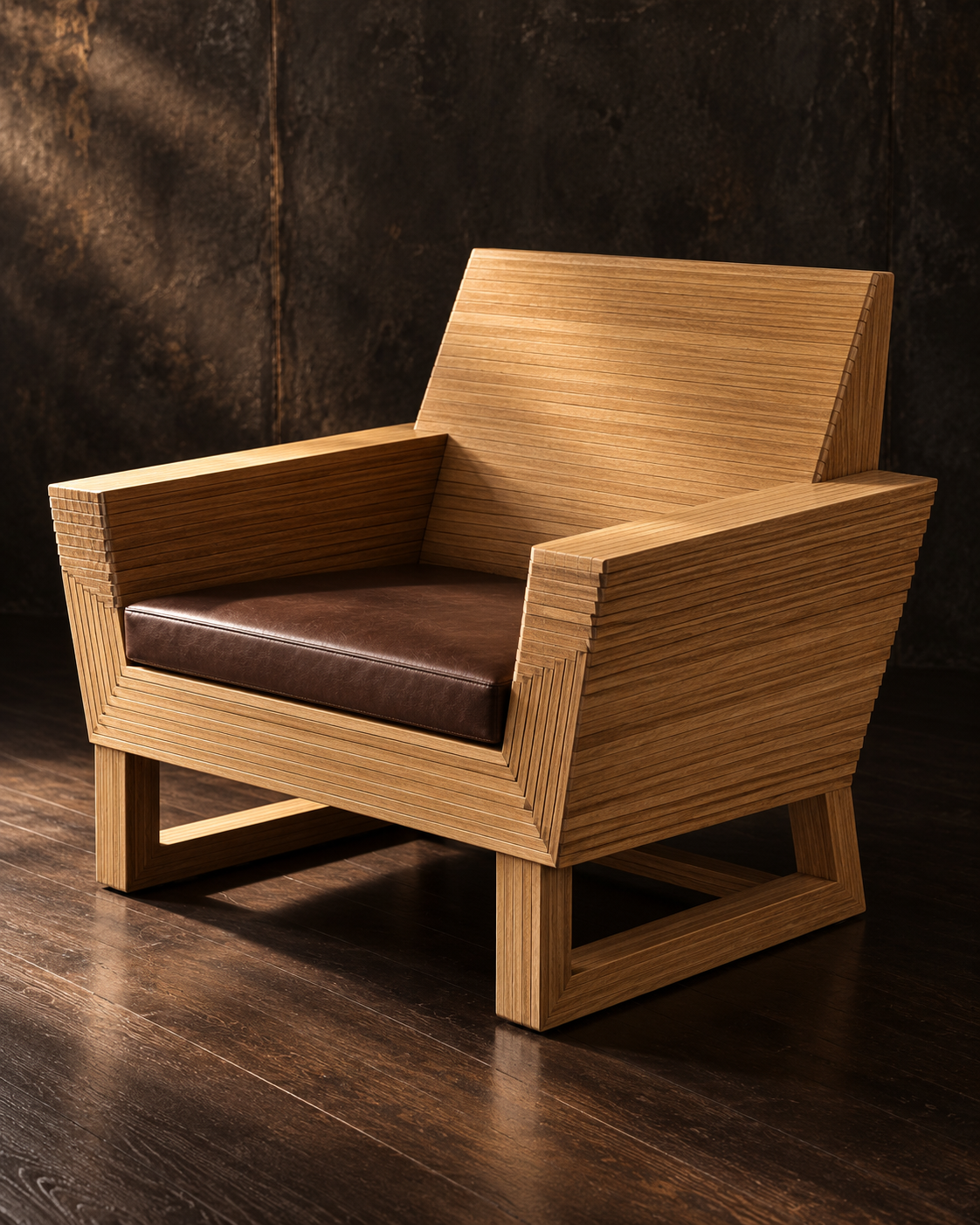
A lounge chair whose entire structure is made from oak strips laid flat and glued into a solid mass, then cut back to shape.
Read full story
The idea came from offcuts. Ten Layers Furniture works with a flooring mill in Gifu that produces short lengths of oak too small to sell, and the studio wanted a product that could absorb them. Stacking the strips horizontally and laminating them into blanks turns a waste stream into stock material, and it leaves the layer lines visible on every cut face.
Those lines do the design work. On the arms they run straight along the length. Where the arm meets the back, the cut passes through the stack at an angle, and the layers fan into a striped wedge that changes width as the section changes. On the sled base, the same lines wrap the frame and read as a continuous ribbed edge. Nothing is applied. Every stripe is a joint.
The seat is a single brown leather cushion, loose, on a webbed platform. The studio kept it plain deliberately, arguing that upholstery on a chair like this only competes with the timber.
The frame is finished in clear hardwax oil. No stain, so the natural variation between strips stays visible and each chair differs.
The jury gave this the category's Platinum for turning a material constraint into the whole appearance of the object. Several jurors noted that the chair explains how it was made simply by being looked at.
Design team
Ten Layers Furniture is a workshop of five in Gifu, started in 2016 by Sho Nakamura after eight years at a Hida furniture maker. The studio builds everything in-house and sells directly, with a lead time of about fourteen weeks. Its whole range is built from laminated offcut stock supplied by two local mills. Nakamura publishes the yield figures for each product, which is unusual, and has spoken at several Japanese trade events about pricing furniture made from waste material.
Furniture Design
Walnut Post Collection
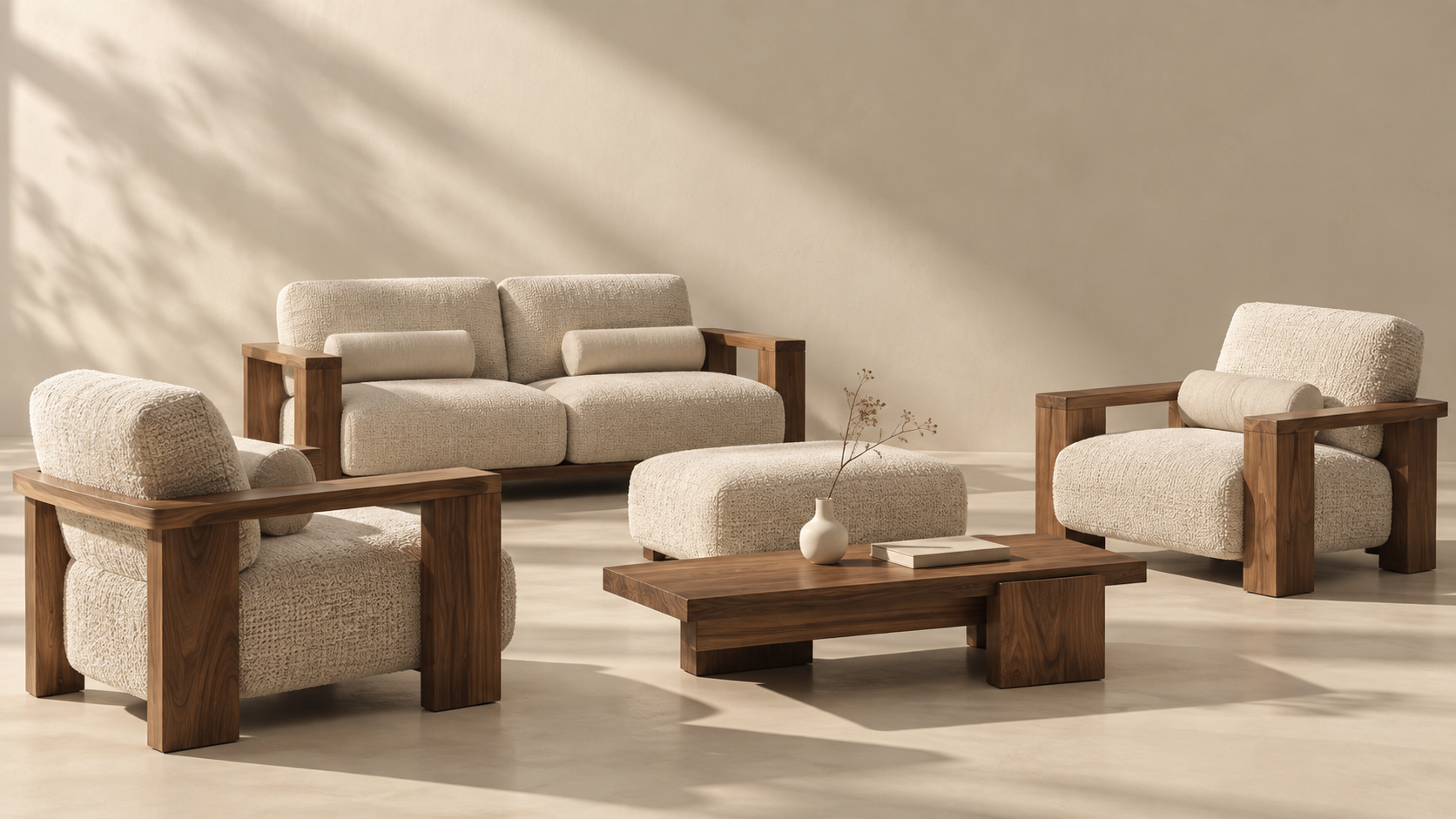
A five-piece living room collection built on one structural idea: a heavy timber post at each corner, with the upholstery sitting inside the frame rather than on top of it.
Read full story
The posts are solid walnut, square in section and left at full thickness, which gives the pieces their weight and their silhouette. Arms are a single plank laid across two posts, wide enough to put a cup on, with a small step where the plank overhangs. Nothing is mitred. Every junction is a flat face meeting a flat face, and the joinery is visible.
Cushions are a coarse cream bouclé, loosely filled, with bolsters instead of fixed back cushions so the seat depth can be adjusted by moving them. The contrast is the point: the frame is rigid and geometric, the upholstery is soft and slightly overfilled, and the two never blend.
The collection covers a two-seat sofa, a lounge chair, an ottoman and a low table, with the table repeating the post-and-plank logic at a smaller scale.
Field House Furniture works in walnut sourced from managed plantations and finishes with a matt oil that darkens slowly.
The jury admired the coherence across the five pieces and the honesty of the joinery. It stopped at Gold because the visual language — thick timber frame, plump neutral bouclé — is currently widespread, and because the ottoman adds little that the chair does not already say.
Design team
Field House Furniture is based outside Yogyakarta and employs thirty-one people, most of them in the workshop. Founded in 2012 by Rangga Wijaya, the company began as a contract manufacturer for European brands and moved to its own designs in 2019. It runs an in-house drying kiln and a training programme that takes six apprentices a year from nearby villages. Its collections are sold through showrooms in Jakarta, Singapore and Sydney. Wijaya leads design with two in-house draughtsmen, and the company still takes contract work for one European client, which funds its own development.
Furniture Design
Soft Tube Seating
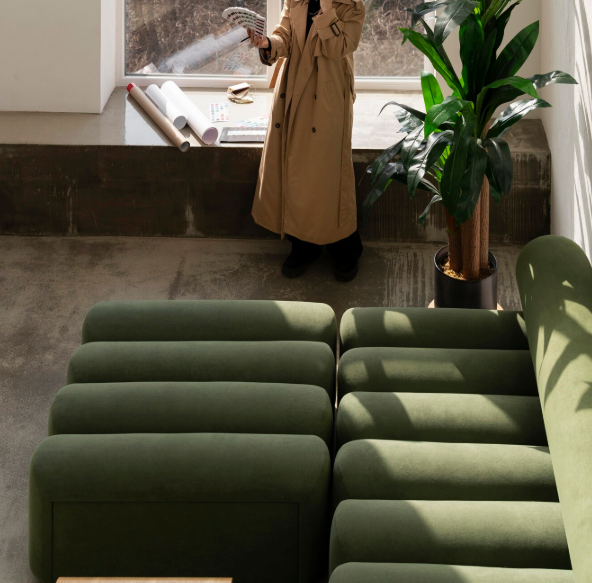
A modular bench system for waiting areas, lobbies and offices, built from padded tubes stacked horizontally on a plinth.
Read full story
The unit is a single width, roughly 700 mm, and can be linked in a straight run, turned into an L, or set back to back. Four tubes make the seat and a fifth, taller module, clips on to form a back. Because the tubes read as a repeating pattern rather than as individual seats, a long run does not look like a row of chairs, which was the studio's main objective: a system that could fill a big room without dividing it into places to sit.
Upholstery is a dense cotton velvet, chosen for how it takes light. In the photograph the sun crosses the run diagonally, and the tubes read as alternating bands of dark and bright green, which is the effect the studio designed for. Covers are removable and zip off individually, so one damaged tube can be replaced rather than the whole unit.
Underneath, a plywood plinth with a recessed base gives the impression that the seating rests directly on the floor.
The jury liked the modularity and the practical cover system, and thought the velvet a brave specification for a contract product that survives inspection. Gold rather than Platinum because tube-based soft seating is a crowded field, and the back module attaches less convincingly than the rest of the system.
Design team
Round Corner Studio is a four-person office in Copenhagen, founded in 2020 by Freja Lund and Oskar Bendtsen after both left larger contract furniture brands. The studio designs exclusively for contract clients and does not sell direct. It prototypes in a shared workshop in Nørrebro and works with two Polish manufacturers. Its stated position is that contract furniture should be repairable at component level, and every product it has released so far ships with replaceable covers.
Furniture Design
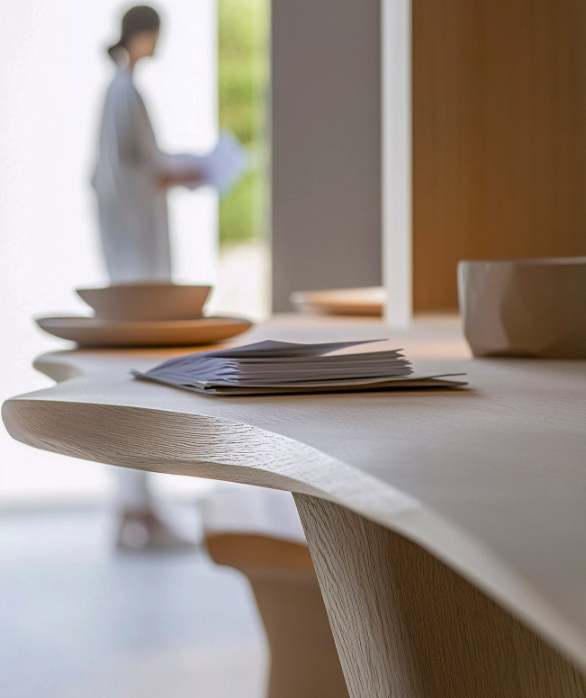
Wave Edge Table
A dining table with a shaped edge that rises and falls along its length, carved rather than cut.
Read full story
The top is European oak, bleached almost white and finished with a heavy brushed texture that opens the grain and catches side light. Instead of a straight or radiused edge, the perimeter undulates in shallow waves, thickening where the curve dips and thinning where it lifts. The wave is not decorative trim. It is cut from the solid, so the section changes across the whole width of the board, and the underside follows the same profile.
Legs are two shaped slabs in the same oak, splayed slightly and blended into the top without a visible joint, which required the top and leg blanks to be laminated together before shaping.
The result reads as one continuous form rather than a top on a base, and it is meant to be touched: the brushed grain is coarse enough to feel, and the edge has no sharp line anywhere on it.
Sand Table Works makes each table to order and matches the wave to the length, so no two are identical.
The jury enjoyed the surface treatment and the quality of the blending at the leg junction. It sits at Selection because the sculpted-edge table is a familiar type, and because the submission showed the table only in close-up, giving the jury little sense of how it works at full size.
Design team
Sand Table Works is a two-person workshop near Aveiro, run by Diogo Matos and Ana Ferreira since 2018. Both came from boatbuilding, which explains the shaping technique and the tolerance for laminated blanks. The studio makes tables only, to order, at a rate of about twenty a year, and sells mainly through architects. It works exclusively in oak and ash from Portuguese and French suppliers, and offers a refinishing service for any table it has built. Matos does the shaping and Ferreira the finishing, and the two share the client work between them.
Furniture Design
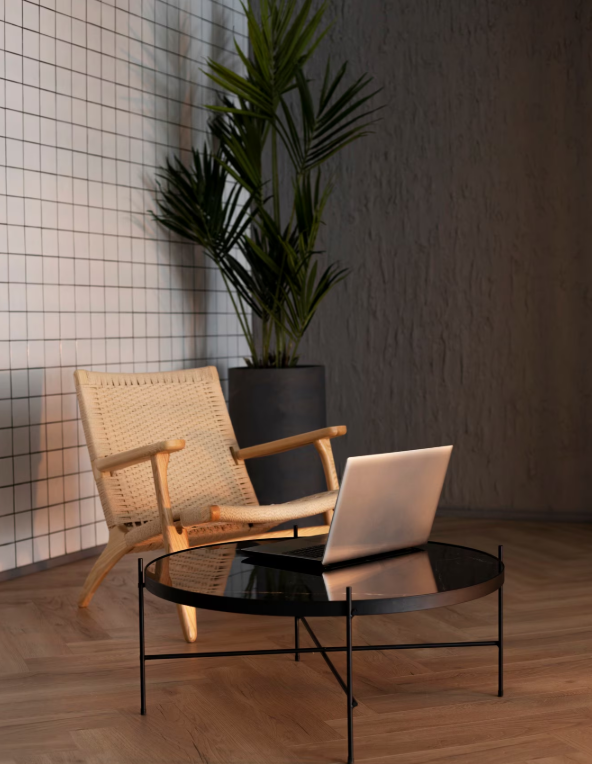
Black Tray Table
A round coffee table built from two crossed steel lines and a smoked glass tray.
Read full story
The frame is 10 mm solid steel rod, bent into two hoops that cross at the base and rise to form a ring under the top. Because the rod is thin and finished in matt black, the table almost disappears in a dark room, leaving the glass floating. The crossing detail at the floor is the only joint, welded and ground flush.
The top is a single disc of smoked glass with a shallow upturned lip, silicone-set into the ring so it can be lifted out and cleaned. The lip is functional as well as visual: it stops objects sliding off a surface that is genuinely slippery.
At 780 mm across and 420 mm high, the table is sized to sit beside a low lounge chair rather than in front of a sofa.
Two Lines Furniture builds the frames in its own workshop in Ho Chi Minh City and buys the glass locally. Flat-packed, the table ships in a box 90 mm deep.
The jury found the proportions good and the packing efficient. It placed the entry at Selection because the design is a light variation on a well-established type, and because the smoked glass, while handsome in the photograph, shows fingerprints badly in use.
Design team
Two Lines Furniture is a workshop of twelve in Ho Chi Minh City, founded in 2019 by Trần Minh Quân. The company makes steel-framed furniture for cafés, hotels and direct retail across Vietnam and has recently begun exporting to Thailand and Singapore. It designs for flat packing from the outset, and its stated aim is to keep every product under a 100 mm carton depth. All welding and powder coating is done in-house. Quân trained as a mechanical engineer and still draws every frame himself, with a small team handling sampling and quality checks.
Explore the full AXIS-SG archive.
Return to all winning years.